
A DHI hair transplant moves your own follicles, one at a time, from the back of the head to the areas that have thinned. It is usually done in a single session under local anaesthesia. Most of the real work happens in the planning before and the patience after, as the full result takes around 12 months.
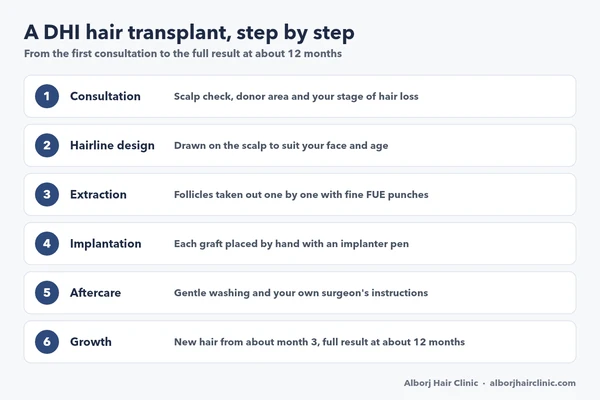
This guide follows the whole journey in order: the consultation, hairline design, extraction, implantation with the pen, aftercare and the slow months of regrowth.
What happens at the first consultation?
The consultation decides whether a transplant makes sense at all. The surgeon checks where you are thinning, how fast it is changing and how much healthy hair grows at the back and sides.
That back-and-sides zone is called the donor area. Hair there usually resists thinning, which is why it is used. Its density sets a limit on how much can be moved, so the scalp check matters more than any wish list.
Men’s hair loss is usually staged on the Norwood scale and women’s on the Ludwig scale. Knowing your stage helps the surgeon plan for today and for the years ahead. It helps to arrive with:
- A rough history of when you first noticed thinning and whether it has sped up.
- A list of your health conditions and medicines, so the surgeon has the full picture.
- Your practical questions, such as time off, washing and when you can go back to your usual styles.
How is the new hairline designed?
For anyone who cares about how their face is framed, this is the step that matters most. Before anything starts, the surgeon draws the proposed hairline on the scalp, and you check it in the mirror together.
A natural hairline is rarely a straight line. It has a soft, slightly uneven front edge and a height in keeping with your age and face shape. It also needs to look right in ten or twenty years, because the original hair around it can still thin.
“I design a hairline for the face the patient will have in twenty years, not only the face they have today. A slightly softer, more conservative line tends to age well and leaves room to plan if the surrounding hair thins later.”
How are the follicles taken out?
Extraction comes first on the day. Once the local anaesthesia has taken effect, the surgeon removes follicles one by one from the donor area using fine FUE punches. Most people describe mild discomfort, with little or no pain.
Each follicle comes out as a follicular unit, or graft: a natural group of about two to four hairs. The donor area is usually trimmed short beforehand to make this easier. Because grafts are taken individually, no stitches are needed.
Spreading extraction evenly across the donor area, rather than taking from one patch, helps the back of the head keep a natural density.
What does the implanter pen actually do?
This is the step that gives DHI its name. Each graft is loaded into a fine implanter pen and placed straight into the thinning area by hand.
Working one graft at a time gives the surgeon close control over the details that make hair look like it has always been there:
- Angle. Hair leaves the scalp at a slant, not straight up, so each graft is set at a matching angle.
- Direction. Hair at the front, temples and crown points different ways, and each graft follows the pattern around it.
- Spacing. Grafts are spread so the new hair blends with the hair you already have.
Those three details are what you notice later when you sweep your hair back or wear it with a side parting.
What is aftercare like in the first weeks?
The first days are about protecting the new grafts. Small scabs often form around them and fall away over the first couple of weeks. Your clinic will show you how to wash your hair gently in the meantime.
Timings vary by clinic and by person, so treat these as typical ranges, not fixed rules:
- Exercise. Many clinics advise skipping workouts and heavy lifting for around a week or two.
- Swimming and saunas. These are often put off for a few weeks while the scalp heals.
- Sun. Many clinics advise keeping the scalp shaded for the first weeks, which matters under the strong Dubai sun.
- Hats. A loose, clean cap is often allowed after the first week or so, while tight hats usually wait longer.
- Colour and heat styling. These are often left until the scalp has fully healed, which can take several weeks.
Always follow your own surgeon’s instructions. They are based on your scalp and your procedure, not on a general list.
When will you see the final result?
Slowly, and that is normal. It is common for the transplanted hairs to shed within the first few weeks. It can feel unsettling, but the follicles stay in place and rest before they start growing again.
The first new hairs usually appear at around three months, often fine and soft. They thicken over the following months, and the complete result shows at around 12 months.
Once established, transplanted follicles normally keep growing for life. You can cut, colour and style them like the rest of your hair.
About Alborj Hair Clinic
Alborj Hair Clinic is a hair transplant clinic in Mazaya Centre, Al Wasl, Dubai. Its surgeon, Dr Dimitrios Ziakas, has 24 years of experience and has performed more than 4,000 hair transplant procedures. He is a member of the International Society of Hair Restoration Surgery (ISHRS) and uses the DHI (Direct Hair Implantation) technique.
You can read more about the clinic’s approach to DHI at alborjhairclinic.com.
Its website also includes before-and-after case studies that follow how results develop over the months.
Frequently asked questions
Is DHI the same as FUE?
They are closely related. Both take follicles out one by one with fine punches. In DHI, each graft is then placed straight into the thinning area with an implanter pen.
Does DHI need stitches?
No. Follicles are taken out individually rather than as a strip of skin, so there is nothing to stitch.
When can I colour my hair after a DHI transplant?
Many clinics advise waiting until the scalp has fully healed, often several weeks. Your own surgeon will confirm the right timing for you.
Will people notice I have had a transplant?
In the first days, small scabs and some redness may be visible. Once these heal and the donor area grows back, it is usually hard to tell.