Category

Hair loss

Category

A DHI hair transplant moves your own follicles, one at a time, from the back of the head to the areas that have thinned. It is usually done in a single session under local anaesthesia. Most of the real work happens in the planning before and the patience after, as the full result takes around 12 months.

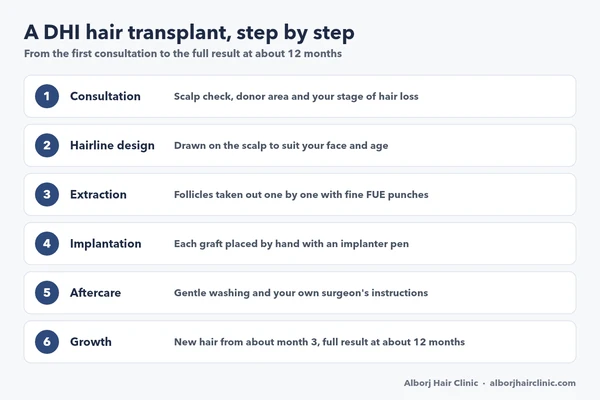
This guide follows the whole journey in order: the consultation, hairline design, extraction, implantation with the pen, aftercare and the slow months of regrowth.

What happens at the first consultation?

The consultation decides whether a transplant makes sense at all. The surgeon checks where you are thinning, how fast it is changing and how much healthy hair grows at the back and sides.

That back-and-sides zone is called the donor area. Hair there usually resists thinning, which is why it is used. Its density sets a limit on how much can be moved, so the scalp check matters more than any wish list.

Men’s hair loss is usually staged on the Norwood scale and women’s on the Ludwig scale. Knowing your stage helps the surgeon plan for today and for the years ahead. It helps to arrive with:

  • A rough history of when you first noticed thinning and whether it has sped up.
  • A list of your health conditions and medicines, so the surgeon has the full picture.
  • Your practical questions, such as time off, washing and when you can go back to your usual styles.

How is the new hairline designed?

For anyone who cares about how their face is framed, this is the step that matters most. Before anything starts, the surgeon draws the proposed hairline on the scalp, and you check it in the mirror together.

A natural hairline is rarely a straight line. It has a soft, slightly uneven front edge and a height in keeping with your age and face shape. It also needs to look right in ten or twenty years, because the original hair around it can still thin.

“I design a hairline for the face the patient will have in twenty years, not only the face they have today. A slightly softer, more conservative line tends to age well and leaves room to plan if the surrounding hair thins later.”

How are the follicles taken out?

Extraction comes first on the day. Once the local anaesthesia has taken effect, the surgeon removes follicles one by one from the donor area using fine FUE punches. Most people describe mild discomfort, with little or no pain.

Each follicle comes out as a follicular unit, or graft: a natural group of about two to four hairs. The donor area is usually trimmed short beforehand to make this easier. Because grafts are taken individually, no stitches are needed.

Spreading extraction evenly across the donor area, rather than taking from one patch, helps the back of the head keep a natural density.

What does the implanter pen actually do?

This is the step that gives DHI its name. Each graft is loaded into a fine implanter pen and placed straight into the thinning area by hand.

Working one graft at a time gives the surgeon close control over the details that make hair look like it has always been there:

  • Angle. Hair leaves the scalp at a slant, not straight up, so each graft is set at a matching angle.
  • Direction. Hair at the front, temples and crown points different ways, and each graft follows the pattern around it.
  • Spacing. Grafts are spread so the new hair blends with the hair you already have.

Those three details are what you notice later when you sweep your hair back or wear it with a side parting.

What is aftercare like in the first weeks?

The first days are about protecting the new grafts. Small scabs often form around them and fall away over the first couple of weeks. Your clinic will show you how to wash your hair gently in the meantime.

Timings vary by clinic and by person, so treat these as typical ranges, not fixed rules:

  • Exercise. Many clinics advise skipping workouts and heavy lifting for around a week or two.
  • Swimming and saunas. These are often put off for a few weeks while the scalp heals.
  • Sun. Many clinics advise keeping the scalp shaded for the first weeks, which matters under the strong Dubai sun.
  • Hats. A loose, clean cap is often allowed after the first week or so, while tight hats usually wait longer.
  • Colour and heat styling. These are often left until the scalp has fully healed, which can take several weeks.

Always follow your own surgeon’s instructions. They are based on your scalp and your procedure, not on a general list.

When will you see the final result?

Slowly, and that is normal. It is common for the transplanted hairs to shed within the first few weeks. It can feel unsettling, but the follicles stay in place and rest before they start growing again.

The first new hairs usually appear at around three months, often fine and soft. They thicken over the following months, and the complete result shows at around 12 months.

Once established, transplanted follicles normally keep growing for life. You can cut, colour and style them like the rest of your hair.
Article image

About Alborj Hair Clinic

Alborj Hair Clinic is a hair transplant clinic in Mazaya Centre, Al Wasl, Dubai. Its surgeon, Dr Dimitrios Ziakas, has 24 years of experience and has performed more than 4,000 hair transplant procedures. He is a member of the International Society of Hair Restoration Surgery (ISHRS) and uses the DHI (Direct Hair Implantation) technique.

You can read more about the clinic’s approach to DHI at alborjhairclinic.com.

Its website also includes before-and-after case studies that follow how results develop over the months.

Frequently asked questions

Is DHI the same as FUE?

They are closely related. Both take follicles out one by one with fine punches. In DHI, each graft is then placed straight into the thinning area with an implanter pen.

Does DHI need stitches?

No. Follicles are taken out individually rather than as a strip of skin, so there is nothing to stitch.

When can I colour my hair after a DHI transplant?

Many clinics advise waiting until the scalp has fully healed, often several weeks. Your own surgeon will confirm the right timing for you.

Will people notice I have had a transplant?

In the first days, small scabs and some redness may be visible. Once these heal and the donor area grows back, it is usually hard to tell.

Hair loss is a common concern that affects millions worldwide, regardless of fame or fortune. Over the years, many celebrities have turned to hair transplantation to restore their youthful appearance and confidence. Their transformations not only inspire fans but also bring attention to the effectiveness and advancements in modern hair restoration techniques.

If you’ve been considering a hair transplant, the experiences of celebrities can offer valuable insights into the procedure, its benefits, and what to expect.

Why Celebrities Opt for Hair Transplants

For celebrities, appearance plays a crucial role in their careers. Whether they are actors, athletes, or musicians, their looks often influence their public image and professional opportunities. Hair transplants provide a long-term solution to hair loss, ensuring a natural and lasting result without the stigma of baldness.

Some of the key reasons why celebrities choose hair transplantation include:

  • Career longevity: A full head of hair often makes them appear younger, maintaining their relevance in the industry.
  • Public scrutiny: Celebrities are always in the limelight, making hair loss more noticeable.
  • Confidence boost: Hair restoration enhances self-esteem and eliminates insecurities related to baldness.

Famous Celebrity Hair Transplant Transformations

Many celebrities have undergone successful hair transplants, proving that the procedure is both effective and life-changing. Here are a few well-known transformations:

Wayne Rooney (Footballer)

The former England footballer openly admitted to undergoing a follicular unit extraction (FUE) hair transplant in 2011. His decision to share his journey helped normalize hair transplantation among men, particularly younger individuals experiencing early baldness. Learn more on Wikipedia.

Elon Musk (Entrepreneur)

Although not officially confirmed, before-and-after pictures of Elon Musk suggest that he has undergone a hair transplant. The transformation from a receding hairline in the late 1990s to a fuller head of hair today showcases the effectiveness of modern transplant techniques. Check Elon Musk’s Wikipedia profile.

Matthew McConaughey (Actor)

Hair Transplants

The Hollywood actor once spoke about his struggle with hair loss and how he managed to regain his thick locks. While he has credited his regrowth to topical treatments, experts believe he might have had an FUE transplant. Read about Matthew McConaughey on Wikipedia.

John Travolta (Actor)

Famous for his roles in Grease and Pulp Fiction, Travolta has experienced noticeable hair loss over the years. His decision to undergo a transplant or use hairpieces has helped him maintain a youthful appearance. Learn more about John Travolta here.

What We Can Learn from These Transformations

Hair Transplants Are Effective and Natural

Modern hair restoration techniques, such as FUE (Follicular Unit Extraction) and FUT (Follicular Unit Transplantation), provide natural-looking results with minimal scarring. Celebrities with hair transplants prove that the procedure can seamlessly blend with existing hair, making it virtually undetectable.

Open Conversations Reduce Stigma

Wayne Rooney’s openness about his procedure helped break the stigma surrounding hair transplants. Today, more people feel comfortable seeking treatment without fear of judgment.

Choosing the Right Clinic is Essential

Celebrities have access to the best surgeons, ensuring high success rates. For anyone considering a hair transplant, selecting a reputable clinic with skilled professionals is crucial for optimal results. If you’re looking for expert hair transplant services in India, Clinic Reborn offers advanced solutions tailored to individual needs.

Hair Restoration is Becoming Mainstream

The influence of celebrities has made hair transplants more socially acceptable and mainstream. More men and women are now exploring hair restoration options to regain confidence. Learn more about the growing popularity of hair transplants in this detailed article.

Conclusion

Celebrities have played a significant role in destigmatizing hair transplantation and showcasing its transformative power. Whether you’re experiencing hair loss due to genetics, aging, or medical conditions, a hair transplant can be a game-changer in restoring both hair and confidence.

If you’re considering hair restoration, consult a trusted clinic like Clinic Reborn to explore the best treatment options. With advancements in technology and expert care, achieving natural, long-lasting results is now more accessible than ever.

In the 21st century’s most advanced cultural state, having a thick mane of hair is synonymous with being young and energetic, exuding self-assuredness. Baldness, a condition affecting most people, can now be treated, significantly improving both appearance and mental health. This is why hair rehabilitation, one of the most recent procedures, has gained popularity.

Colombia is a highly frequented destination for cosmetic and medical tourism. Among its many sought-after procedures, hair transplantation is rising in popularity. Both men and women are fond of hair extensions and don’t mind paying for better looks. in Colombia makes beauty treatments accessible and affordable, encouraging more people to achieve their desired appearance

Hair transplant in Bogota

Which Is Better: A Hair System or a Hair Transplant?

A hair transplant is an operative approach designed to restore hair growth by shifting healthy hair from one part of the body, usually the back of the head, to areas with bald patches or thinning hair. This option is appealing because it provides physical enhancement while reducing anxiety, allowing individuals to engage in daily activities confidently.

On the other hand, hair systems serve as a form of camouflage, helping individuals achieve a desired look. While prosthetics can provide a temporary solution, a hair transplant offers long-lasting results.

Colombia: A Hub of Hair Transplantation

Colombia has become a hot spot in the medical tourism market, offering a combination of highly skilled practitioners, high-end facilities, and affordable treatment options, particularly for hair transplants. The country boasts professionals trained in the latest methods, such as FUE (Follicular Unit Extraction) and DHI (Direct Hair Transplantation), ensuring natural results with minimal scarring.

Remarkable Medical Expertise

Colombia’s medical sector stands out for its skilled professionals and excellent services. Hair transplant surgeons undergo rigorous training and stay updated with global advancements in hair restoration. Clinics adhere to international standards of patient care and hygiene, ensuring a safe and comfortable environment. Patients can discuss treatment options, duration, and expected results in detail, easing any fears about the procedure.

Pricing That is Justified and Accessible

Cost is often a deciding factor for those considering hair restoration. Fortunately, Colombia offers affordable pricing, making hair restoration accessible to a wide range of people. Some agencies ensure fairness by avoiding unhealthy competition and offering package surgeries at all-inclusive pricing. This economical approach allows individuals to restore their hair without financial strain, unlike many European options.

A Personal Experience: ColombiaHairTransplant.com

“Every inch of me was trembling, every cell in my body was dancing. I thought I was out of my mind considering medical tourism. It was difficult to keep my cellphone steady as I eagerly opened ColombiaHairTransplant.com. Although I could understand only a quarter of what I saw, the pictures spoke volumes.

Don’t forget to check previous patient reviews to understand the clinics’ treatment quality and prepare accordingly. Pricing transparency ensures all clients receive the same care and attention without exclusionary practices.”

Hair loss is a common issue that many people face. There are different types of hair loss, and each one can be treated in a different way. In this blog post, we will discuss three types of hair loss that can benefit from scalp micropigmentation. Keep reading to learn more!

1. Male-Pattern Baldness

Male-pattern baldness, or androgenic alopecia, is the most common type of hair loss in men. It usually starts with a receding hairline at the front of the head and can extend to complete baldness at the crown. Scalp micro-pigmentation (SMP) is an effective treatment option for male-pattern baldness.

The SMP procedure involves injecting tiny amounts of pigment into the scalp to replicate the appearance of short, shaved hairs. SMP can help to restore a full and even hairline, which can be an effective solution for men with male-pattern baldness. You just have to make sure to consult with a qualified technician for scalp micropigmentation for men in Atlanta to get the best results. They can help you decide the right color and pattern for your SMP treatment in order to create a natural look.

2. Alopecia Areata

Alopecia areata is an autoimmune disease that causes patchy hair loss on the scalp and other parts of the body. It is often caused by a combination of genetic and environmental factors, but it can also be triggered by stress or illness. Scalp micro-pigmentation can be used to help disguise the bald patches caused by alopecia areata. It further helps to create a more even coverage of the scalp and provides the patient with a more aesthetically pleasing appearance.

3. Hair Thinning

Hair thinning is a common condition that affects both men and women. It occurs when the hair strands become finer, shorter, and fewer in number. The causes of hair thinning can vary from person to person, but some possible causes include hormonal imbalances, medication side effects, and age-related changes.

Scalp micro-pigmentation can help to address the issue of hair thinning. It can give the appearance of a fuller head of hair and can help to make the scalp look more even. As a result, people with thinning hair can feel more confident in their appearance.

Wrapping Up

These are just a few of the hair loss types that can benefit from scalp micropigmentation. If you are considering undergoing SMP treatment, it is important to consult with a qualified technician in order to get the best results. A good technician will be able to evaluate your hair loss type and provide you with a customized treatment plan that is tailored to your individual needs. With the right SMP treatment, you can achieve a fuller and more even-looking head of hair.